Discover 10 simple mindfulness exercises to calm your mind and reduce stress. Learn practical techniques like mindful breathing, body scans, and grounding methods for daily peace and emotional balance.
In our fast-paced world filled with endless notifications, competing demands, and constant mental chatter, finding moments of calm can feel like searching for silence in a storm. Yet within you lies an innate capacity for peace, accessible through the transformative practice of mindfulness. These simple mindfulness exercises offer a pathway to reclaim your mental clarity, ease stress, and cultivate a deeper sense of presence in everyday life.
Whether you’re new to mindfulness or seeking to refresh your practice, this comprehensive guide provides practical, evidence-based techniques you can start using today. No special equipment, no perfect conditions, no prior experience necessary—just you, this moment, and a willingness to pause.
Table of Contents
Understanding Mindfulness: More Than Just Meditation
Before diving into specific exercises, it’s helpful to understand what mindfulness truly means. At its core, mindfulness is the practice of paying attention to the present moment with openness, curiosity, and without judgment. It’s about observing your thoughts, emotions, and sensations as they arise, rather than getting swept away by them or pushing them aside.
Mindfulness isn’t about emptying your mind or achieving a blissful state free from thoughts. Instead, it’s about changing your relationship with your thoughts—observing them like clouds passing through the sky rather than identifying with every mental storm that rolls through.
Research from neuroscience has shown that regular mindfulness practice can actually reshape your brain. Studies using MRI scans reveal that consistent mindfulness meditation increases gray matter density in areas associated with learning, memory, emotional regulation, and perspective-taking. Meanwhile, the amygdala—your brain’s alarm system responsible for stress and anxiety—shows decreased activity and connectivity after mindfulness training.
Why Mindfulness Helps Calm Your Mind
Mindfulness encourages mindful awareness—noticing thoughts, feelings, and sensations without judgment. This awareness gives you choices about how to respond, rather than reacting automatically. When you’re mindful, you create space between stimulus and response, a gap where wisdom and intentional action can emerge.
Practicing mindfulness regularly cultivates relaxation, emotional balance, and a clearer mind. These benefits come from steady practice and simple, repeatable exercises rather than one-time fixes. The cumulative effect of daily mindfulness is like compound interest for your mental health—small, consistent deposits that grow into substantial well-being over time.
Beyond stress reduction, mindfulness offers a range of scientifically documented benefits:
- Improved focus and concentration: Training your attention muscle helps you stay present with tasks and reduces mental distraction
- Enhanced emotional regulation: You learn to ride emotional waves rather than being capsized by them
- Better sleep quality: A calm, less reactive mind naturally transitions into rest more easily
- Reduced rumination: Mindfulness interrupts the cycle of repetitive negative thinking
- Increased self-compassion: Observing your experience without judgment naturally extends kindness inward
- Lower blood pressure and improved immune function: The mind-body connection means mental calm translates to physical health
10 Simple Mindfulness Exercises to Calm Your Mind
1. Mindful Breathing: Your Portable Anchor
Sit or stand comfortably. Close your eyes if that feels safe, and bring attention to the breath. Notice the inhale and exhale, the rise and fall of your chest or belly. Feel the sensation of air moving through your nostrils—perhaps slightly cooler on the inhale, warmer on the exhale.
If your mind wanders, gently return to the breath. Even one to three minutes of mindful breathing helps calm the nervous system and brings you back to the present moment.
Why it works: Your breath is the bridge between your conscious and unconscious mind. By directing attention to breathing, you activate the parasympathetic nervous system—your body’s natural relaxation response. This counters the fight-or-flight activation that keeps you feeling stressed and on edge.
Variation to try: Count your breaths in a 4-7-8 pattern—inhale for 4 counts, hold for 7, exhale for 8. This specific rhythm further enhances the calming effect and gives your mind a simple task to focus on.
2. Body Scan: Reconnecting With Physical Sensations
Lie down or sit quietly. Slowly move your attention from your toes to the top of your head, noticing sensations—warmth, tension, or ease—without trying to change them. Pause briefly on each area.
Start with your left toes, acknowledging whatever you feel or don’t feel there. Move to the sole of your foot, the arch, the heel, the top of the foot, the ankle. Continue upward through the leg, then repeat on the right side. Progress through your torso, back, arms, hands, neck, face, and crown of your head.
This practice builds awareness of bodily signals and encourages deep relaxation when you notice tension and release softening. Many people discover they’ve been holding stress in their jaw, shoulders, or stomach without realizing it.
Why it works: The body scan strengthens the mind-body connection, helping you recognize stress signals before they escalate. It also activates body areas that may have become numb or dissociated from chronic stress or trauma. By systematically directing attention, you’re essentially giving each part of your body permission to release what it’s been holding.
3. 5-4-3-2-1 Grounding: Anchoring Through the Senses
Use your senses to ground in the present: name 5 things you can see, 4 you can touch, 3 you can hear, 2 you can smell, and 1 thing you can taste.
Take your time with each sense. Really look at those five things—notice their colors, shapes, textures. When touching four items, feel their temperature, their surface quality. Listen deeply to three sounds, perhaps discovering layers of noise you typically filter out.
This quick grounding exercise is great when your mind feels scattered. It brings gentle focus back to the current moment and calms racing thoughts, making it particularly effective during anxiety or panic.
Why it works: Anxiety and worry pull your attention into the future (what might happen) or past (what did happen). The 5-4-3-2-1 technique interrupts this time travel by anchoring you firmly in the present moment through sensory experience. It’s nearly impossible to be fully absorbed in sensory awareness while simultaneously catastrophizing.
4. Mindful Walking: Meditation in Motion
Walk slowly and with intention. Notice the contact of your feet with the ground, the rhythm of your steps, and sensations in your legs and breath. Feel the weight shift from heel to toe, the slight wobble as you balance, the engagement of muscles throughout your legs and core.
Try a short loop outside or even pace in place for a few minutes. Mindful walking turns ordinary movement into a calming mindfulness practice. You can practice this while walking to your car, around your office building, or down a hallway.
Why it works: For people who find sitting meditation challenging, walking meditation offers the benefits of mindfulness combined with gentle physical activity. Movement can actually make it easier to focus, and the rhythmic nature of walking becomes a natural object of attention, much like the breath.
Advanced practice: Try walking meditation at different speeds—from extremely slow motion (lifting your foot and placing it with exaggerated awareness) to a normal pace. Notice how the quality of your attention shifts with speed.
5. Loving-Kindness (Metta) Phrases: Cultivating Compassion
Sit comfortably and silently repeat simple phrases such as “May I be safe, may I be peaceful, may I be well, may I be happy.” After a few breaths, extend the phrases toward someone you care about, then toward someone neutral, and eventually toward someone difficult.
Start with yourself because you cannot offer genuine goodwill to others from an empty cup. The practice typically expands in concentric circles: self, benefactor or loved one, good friend, neutral person, difficult person, and finally all beings.
This practice cultivates warmth and emotional balance, opening the heart and softening stress through gentle intention. It’s particularly powerful when you’re feeling isolated, critical, or disconnected.
Why it works: Loving-kindness meditation activates brain regions associated with empathy and emotional processing while decreasing activity in areas linked to negative self-referential thinking. It directly counters the harsh inner critic many people struggle with and builds neural pathways for self-compassion and connection.
6. Mindful Eating: Savoring Each Bite
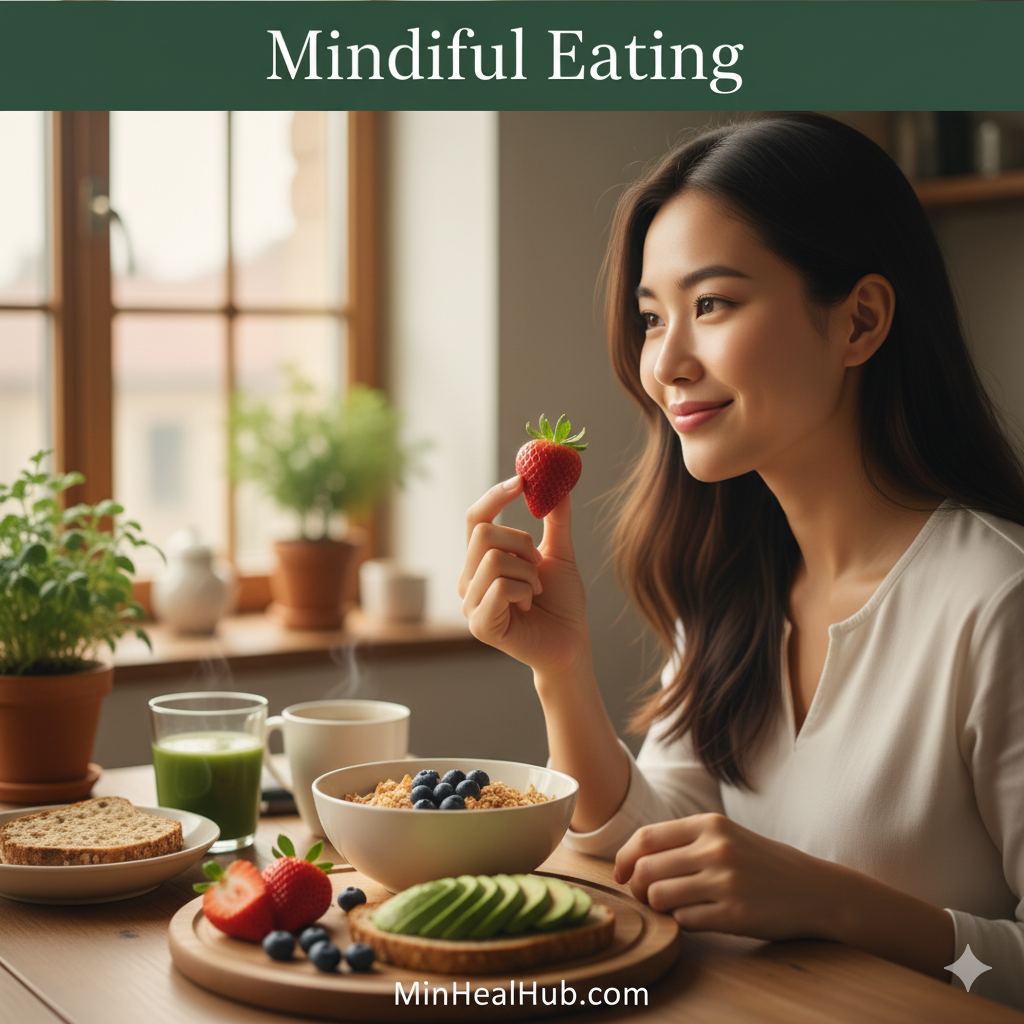
Choose a small piece of food—a raisin, a slice of apple, a square of chocolate—and take a slow, attentive bite. Notice texture, flavor, temperature, and the act of chewing. Before eating, look at the food closely, smell it, feel its weight in your hand.
Place it in your mouth without chewing at first. Notice what happens—does saliva increase? Where does your tongue position the food? Then chew slowly, counting 20-30 chews, noticing how the texture and flavor transform.
Mindful eating awakens your senses and helps you slow down. It’s a calming ritual that invites presence and appreciation at mealtimes. This practice can also transform your relationship with food, reducing emotional eating and increasing satisfaction.
Why it works: We often eat on autopilot, barely tasting our food while our minds race elsewhere. Mindful eating breaks this pattern, helping you recognize actual hunger and fullness cues. It can reduce overeating, improve digestion (which begins with chewing), and restore pleasure to the eating experience.
7. Breath Counting: Focusing the Wandering Mind
After a few normal breaths, count “one” on the next exhale, then inhale and count “two” on the next exhale, up to five, then start again. If you lose track, gently begin at one.
This simple technique focuses the mind and reduces mental chatter, making it a useful short practice during busy days. The counting gives your thinking mind something to do, paradoxically helping it settle down.
Some traditions count to ten, while others stop at five. Experiment to find what works for you. The number matters less than the gentle return to “one” each time you realize your attention has drifted.
Why it works: Counting provides structure for an otherwise open-ended practice. It’s easier for beginners than pure breath awareness because it engages the verbal mind just enough to prevent it from wandering into planning or worrying. You’ll quickly discover how active your mind is, which itself is valuable insight.
8. One-Minute Clear-Out: The Micro-Meditation
Set a timer for one minute. Sit quietly and allow thoughts to come and go like clouds, neither holding onto them nor pushing them away. You’re simply watching, observing the flow of mental activity without getting involved in the content.
You might imagine yourself sitting by a river, watching thoughts float by on leaves, or sitting in a movie theater with thoughts projected on a screen. The key is observing without analyzing or engaging.
Short, regular one-minute practices train your attention and create a calm reset between tasks or meetings. The brevity makes it accessible even on the busiest days—everyone can find one minute.
Why it works: One minute feels doable, removing the resistance many people feel toward longer meditation sessions. It’s also long enough to interrupt stress momentum but short enough that you can repeat it multiple times daily, creating consistent touchpoints with presence throughout your day.
9. Sensory Pause: Quick Presence Check-In
Pause and name one thing you notice in each sensory category: sight, sound, touch, taste, and smell. Keep it brief and matter-of-fact. This isn’t about achieving a perfect meditative state—just noticing what’s already here.
“I see the blue mug on my desk. I hear the hum of the refrigerator. I feel the chair against my back. I taste a slight mint from my toothpaste. I smell coffee in the air.”
A sensory pause is a quick, portable way to calm your mind and reconnect with the present, especially when emotions feel intense or overwhelming. It works anywhere—in meetings, before presentations, during difficult conversations.
Why it works: This exercise requires no special setup or privacy, making it ideal for workplace stress. The simplicity means you can practice dozens of times daily, building a robust habit of checking in with present-moment reality rather than getting lost in mental stories.
10. Guided Imagery: Creating an Inner Sanctuary
Close your eyes and imagine a calm place—a beach, forest, cozy room, or mountain meadow. Notice colors, sounds, and gentle sensations. Feel the warmth of sunlight or coolness of shade. Hear the rhythm of waves, rustling leaves, or crackling fire. Stay there for a few breaths or several minutes.
Engage all your senses in this imagined environment. What would you smell? What textures might you touch? Is there a taste in the air—salt water, pine, fresh rain? Build the scene with rich sensory detail.
Guided imagery invites a sense of safety and relaxation. Use recorded guidance or create your own scene to return to whenever you need a mental break. Your brain responds to vividly imagined experiences similarly to real ones, triggering genuine relaxation responses.
Why it works: Visualization activates the same neural networks as actual sensory experience. When you imagine a peaceful scene in detail, your body responds as though you’re really there—heart rate slows, muscles relax, stress hormones decrease. This makes guided imagery particularly effective for acute stress or when you can’t physically escape a stressful environment.
Read also : A Simple 5-Minute Morning Mindfulness Routine for Journaling, Emotional Balance, and Personal Growth
How to Use These Exercises in Daily Life
Start with one or two practices that feel easiest and realistic for your schedule. Consistency matters more than length: a daily three-minute routine is more powerful than an occasional thirty-minute session. Think of mindfulness practice like brushing your teeth—better to do a little bit every day than a marathon session once in a while.
Combine short exercises across the day—a mindful breath in the morning upon waking, a sensory pause at lunch, and a brief body scan before bed. Over time, these moments build a steady mindfulness practice that helps calm your mind and support emotional balance.
Creating Your Personal Mindfulness Routine
Consider your natural rhythms and existing habits. Are you a morning person who could pair mindful breathing with your first cup of coffee? Would a midday walking meditation fit during lunch? Could you bookmark body scan as part of your bedtime routine?
Morning practices set a tone of intentionality for your day. Even three minutes of mindful breathing or loving-kindness practice before checking your phone can shift your entire day’s trajectory.
Midday practices offer reset points, interrupting the accumulation of stress and bringing you back to center. A one-minute clear-out between meetings or a 5-4-3-2-1 grounding after a difficult email can prevent afternoon burnout.
Evening practices help transition from doing to being, preparing your nervous system for rest. Body scans are particularly effective for sleep, as are breath counting and guided imagery.
Habit Stacking for Mindfulness Success
James Clear, author of “Atomic Habits,” suggests “habit stacking”—linking new behaviors to existing routines. Try these combinations:
- After pouring coffee → three mindful breaths
- While washing hands → sensory pause
- Before eating lunch → mindful eating of first three bites
- After parking car → 5-4-3-2-1 grounding
- While brushing teeth → body scan of face and jaw
- After closing laptop → one-minute clear-out
By anchoring mindfulness exercises to habits you already perform consistently, you remove the friction of remembering and make practice automatic.
Tips for Gentle Practice
Be kind to yourself if your mind wanders—wandering is part of the process, not a failure. Your mind’s job is to think, plan, remember, and imagine. When you notice it has wandered, that noticing itself is mindfulness. The moment you realize you’ve been lost in thought, you’re back in awareness.
Use a friendly internal voice and return your attention without judgment. Instead of “Ugh, I got distracted again, I’m terrible at this,” try “Oh, there’s a thought. Back to the breath.” The tone matters enormously.
Experiment with timing and settings to find what works: some people prefer morning routines, others a midday reset. Keep practices simple and flexible so they integrate into your life rather than becoming another source of pressure.
Common Obstacles and Solutions
“My mind won’t stop thinking”: This is normal and expected. Mindfulness isn’t about stopping thoughts but about changing your relationship with them. Each time you notice a thought and return attention to your anchor (breath, body, sound), you’re strengthening your mindfulness muscle.
“I don’t have time”: Start with just one minute. Literally sixty seconds. Once you experience the benefits, you’ll likely want to expand, but even one minute is infinitely better than zero minutes.
“I feel more anxious when I try to be mindful”: Some people experience increased anxiety initially as they become aware of sensations or thoughts they’ve been avoiding. This is where gentleness matters. Try shorter sessions, eyes-open practices, or movement-based mindfulness like walking meditation. If anxiety persists, consider working with a mindfulness teacher or therapist trained in mindfulness-based interventions.
“I keep falling asleep”: If you’re falling asleep during practice, you might be sleep-deprived (in which case, sleep is what you need!). Try practicing at a different time of day, practicing sitting up rather than lying down, or opening your eyes slightly during practice.
“I’m not sure I’m doing it right”: If you’re making the effort to pay attention to present-moment experience, you’re doing it right. There’s no perfect mindfulness practice. Some sessions will feel calm and others restless—both are valuable opportunities for awareness.
The Science Behind the Calm

Understanding why these practices work can strengthen your commitment to them. Mindfulness exercises directly influence your autonomic nervous system, shifting you from sympathetic activation (fight-or-flight) to parasympathetic dominance (rest-and-digest).
When you practice mindful breathing, you’re literally signaling safety to your brain. Deep, slow breaths activate the vagus nerve—a major nerve that runs from your brain stem through your body, regulating everything from heart rate to digestion. High vagal tone is associated with greater emotional regulation, social connection, and overall well-being.
Brain imaging studies show that just eight weeks of mindfulness practice can produce measurable changes in brain regions associated with memory, sense of self, empathy, and stress. The prefrontal cortex (responsible for executive function and emotional regulation) shows increased activation and connectivity, while the amygdala (your stress center) becomes less reactive.
Perhaps most remarkably, mindfulness practice has been shown to affect gene expression related to inflammation and immune response. This means that the effects aren’t just psychological—they extend to cellular and molecular levels.
Read also : Mindful Tools & Reviews
Building a Sustainable Practice
The key to long-term success with mindfulness is making it sustainable rather than perfect. You’ll have days when you practice and days when you forget. You’ll have sessions that feel peaceful and sessions that feel frustrating. All of this is normal and part of the journey.
Consider keeping a simple practice log—just a checkmark for each day you practice, no matter how briefly. This creates a visual chain you’ll want to keep unbroken, but without the pressure of detailed journaling.
Join a community if possible. Many areas have meditation groups, and there are countless online communities where practitioners share experiences, encouragement, and accountability. Practicing with others, even virtually, strengthens commitment.
Remember that mindfulness is a practice, not a destination. There’s no point at which you’ve “mastered” it and can stop. The practice itself is the point—each moment of awareness is complete in itself.
Conclusion: Your Journey Toward Calm Begins Now
These 10 mindfulness exercises offer simple, accessible ways to calm your mind and invite more presence into your day. Start small, be consistent, and let curiosity guide you. With gentle practice, moments of calm will become easier to find and more meaningful.
You don’t need to wait for the perfect moment or the right circumstances. You don’t need special training or equipment. Everything you need is already within you—the capacity to breathe, to notice, to pause, to return to this moment with kindness.
Begin today with just one exercise. Perhaps mindful breathing for three minutes this morning, or a sensory pause during lunch. Notice what you experience without demanding particular results. Over time, these small moments of presence accumulate, creating a foundation of calm that supports you through life’s inevitable storms.
The mind that feels scattered and overwhelming today can become your greatest ally through mindfulness practice. Each time you pause, breathe, and notice, you’re choosing presence over autopilot, awareness over reactivity, calm over chaos. This choice, repeated daily, transforms not just individual moments but the entire quality of your life.
Your journey toward a calmer mind starts with a single breath. Take it now.
Read also : 5 Life Lessons You Learn Through Stillness
Reference Links:
https://en.wikipedia.org/wiki/Meditation#References
https://en.wikipedia.org/wiki/Mindfulness#References





3 thoughts on “10 Simple Mindfulness Exercises to Calm Your Mind”